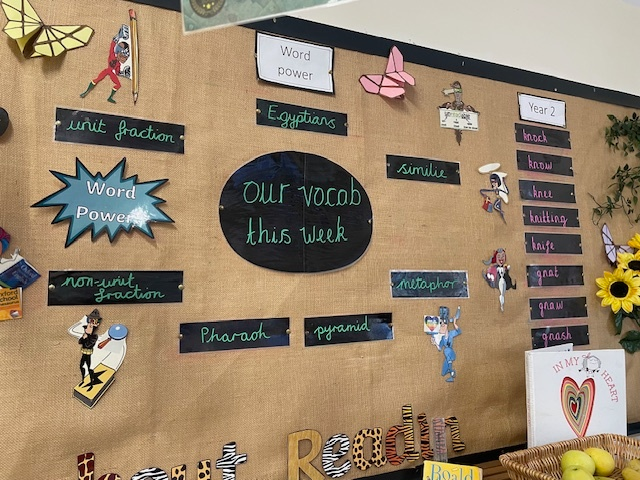

Word Power

Word Power is a multi strategy approach that gives children a range of strategies to help them remember spelling patterns, meanings and rules of directly taught spelling words.
The Word Power approach has been developed by Kelly Ashley and more information regarding this can be found at Word Power .
Intent
Through Word Power we intend to:
- ensure children have a range of word-learning strategies to help them spell
- amplify vocabulary instruction
- have words at the heart of who we are and how we learn
- develop the meta-cognition of all our children
- expand vocabulary development for every child
- establish spelling strategies in the children’s long term memory
Implementation
- The direct teaching of spelling incorporates phonology, graphology, orthography, etymology and morphology activities
- Children are directly taught sets of spelling rules from the National Curriculum
- Children access challenges through a ‘self-led’ approach
- Children discuss and debate the meaning of new/ known words
- Opportunities are provided for pupils to use new words encountered in a range of activities
- Words chosen for writing are analysed – we share why these words are the right choice for the intended audience, purpose and context.
- We extend word knowledge in different contexts, across the curriculum
The Word Power approach is centred around 3 key areas:
- Unlock word and word knowledge - consider the vocabulary ‘diet’ on offer for your pupils
- Power-Up expressive and receptive language - amplify words as part of direct instruction for Power Practice, using the eight Power-Up strategies
- Charge and recharge to strengthen word memory over time - strategies for building word memory, retrieval and retention over time
We ensure pupils secure the essential foundational knowledge, beginning in Early Years, that enables them to build increasingly complex understanding over time, so that the curriculum is coherently sequenced, cumulative, and helps all children know more and remember more. A typical lesson structure looks like this:
·
|
Lesson Structure |
Key Actions |
|
|
Activate prior knowledge |
Pupils write a short dictated sentence using previously taught spelling rules. |
|
|
State today’s focus |
Introduce the rule/pattern, when it is used (condition), and when it is not (exception). |
|
|
Explicit explanation |
Define the pattern in simple language; show morpho/phonics link (sound–grapheme, morpheme); explain meaning using etymology and related words. |
|
|
Teacher modelling (I do) |
Live model 2–3 words: segment → model/think aloud → write → check. |
|
|
Guided practice (We do) |
Pupils spell words step-by-step with teacher; use mini whiteboards/books; reveal and correct together. |
|
|
Rule application (You do) |
Applying the new pattern; pupils write age-appropriate phrases/sentences using target words. |