
Music
Music in Early Years (Key foundational knowledge)
Music in the Early Years is mainly taught through ‘Expressive Arts and Design’.
The EYFS Framework states:
The development of children’s artistic and cultural awareness supports their imagination and creativity. It is important that children have regular opportunities to engage with the arts, enabling them to explore and play with a wide range of media and materials. The quality and variety of what children see, hear and participate in is crucial for developing their understanding, self-expression, vocabulary and ability to communicate through the arts. The frequency, repetition and depth of their experiences are fundamental to their progress in interpreting and appreciating what they hear, respond to and observe.
The table below outlines the aspects of the Elevate EYFS Curriculum that feed into our Music curriculum progression:
|
Reception (4-5 year olds) |
Early Learning Goals |
|
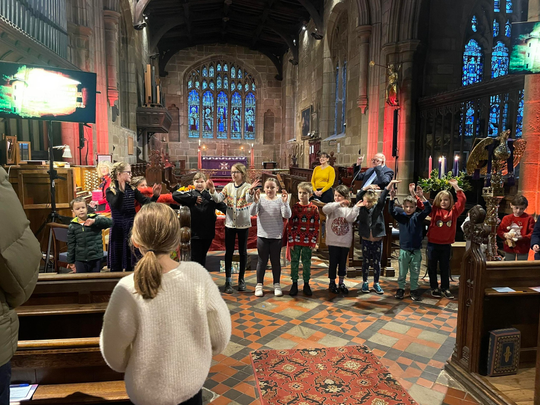
Being Imaginative and Expressive Remembers and sings some favourite songs and rhymes. Listen attentively and respond to what they have heard, expressing their thoughts and feelings. Taps out simple repeated rhythms. Creates sounds, movements and drawing to accompany stories. Sings to self and creates their own songs, or improvise a song around one they know. Sing in a group or on their own, increasingly matching the pitch and following the melody. Play instruments with increasing control to express their feelings and ideas. Makes music in a range of ways Experiments and create movement in response to music, stories and ideas. To learn music can be affected by your emotions/ feelings. To enjoy moving in time to music. To find the pulse to a range of different songs. To copy rhythm patterns using movement To explore high and low voice sounds |
ELG: Creating with Materials
Share their creations, explaining the process they have used;
ELG: Being Imaginative and Expressive
Sing a range of well-known nursery rhymes and songs;
Perform songs, rhymes, poems and stories with others, and |
|
Vocabulary Pulse Rhythm- fast/ slow Pitch- high/ low/ loud/ quiet/ soft |
|
Intent
- Children gain pleasure from a variety of genres of music.
- Children develop an understanding of musical notation in order to perform compositions.
- Children develop a deeper understanding of how music was/is created.
- Children can express themselves creatively and experience a real sense of achievement in performance.
Implementation
The National Curriculum for music is taught to all year groups through a 3-strand approach:
- Listening and Appraising
Children listen to and explore music produced by others and themselves.
They express their ideas and feelings about music and consider its intended effects.
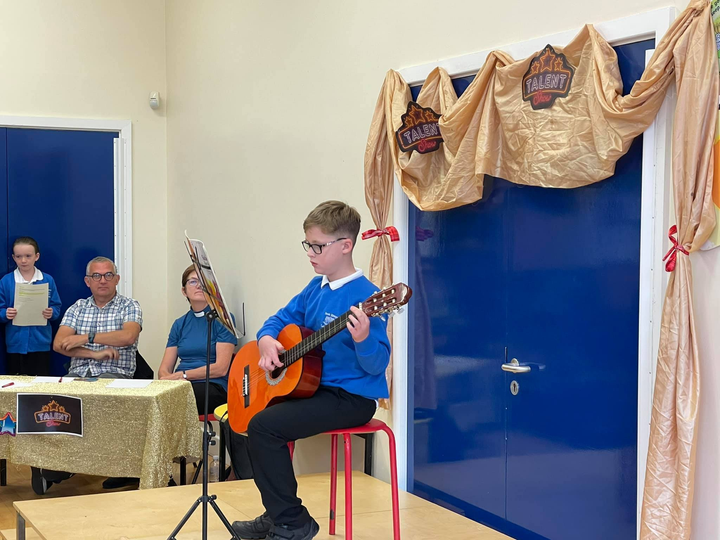
- Playing and Performing
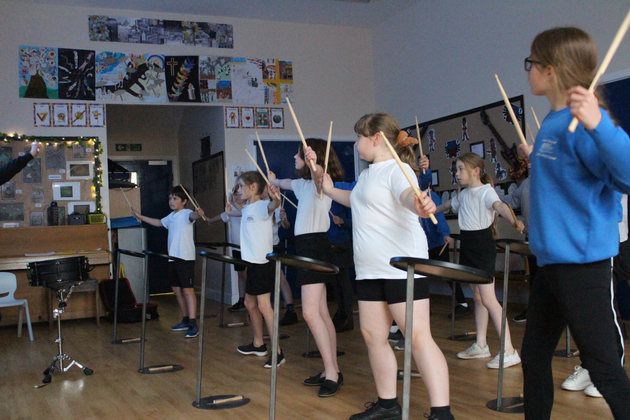
Children learn to use their voice expressively and move onto singing in a range of styles and forms. They play a range of tuned and un-tuned instruments and take part in performances for a wide range of audiences.
- Creating and Composing
Children create a variety of music through improvisation and composition, they use their voices and instruments.
- A clear progression in knowledge, skills and vocabulary is taught throughout the school starting at Early Years through to year 6 to ensure connections are clear, coverage is met and the sequence builds on skills as children progress through school.
- Trio Time is used to retrieve and reinforce previously taught knowledge in order to consolidate prior learning, this is discussed verbally at the start of music lessons.
- Charanga (our primary music resource) is used to support the delivery of music teaching across school.
- Teachers assess and adapt teaching for all groups of learners, specifically providing extra targeted support and challenge for SEND, pupil premium and our most vulnerable children.
- We ensure pupils secure the essential foundational knowledge, beginning in Early Years, that enables them to build increasingly complex understanding over time, so that the curriculum is coherently sequenced, cumulative, and helps all children know more and remember more.
- Vocabulary is shared, discussed and revisited in lessons and as children progress through school.
Impact
- Pupils will confidently and knowledgably articulate their learning in music.
- Children will be exposed to a wide range of musical genres.
- Children will discuss and compare musical pieces and performances.
- Children will develop their confidence when composing, playing and performing.