Physical Education
We have now received the School Games Platinum award for 4 consecutive years. Here is what our SGO has to say about our commitment to sport and PE:
We believe every child should access high‑quality PE that develops safe, efficient and intelligent movement, ensuring they build motor competence, rules and strategies and healthy participation. We aim for all pupils to be physically active. This approach ensures our PE provision aligns with our vision of competence‑focused, inclusive, knowledge‑rich PE that equips children to live healthy, active lives.
PE in Early Years (Key foundational knowledge)
PE in the Early Years is mainly taught through ‘Physical Development’ and ‘Personal Development’.
The EYFS Framework states:
Physical Development
Physical activity is vital in children’s all-round development, enabling them to pursue happy, healthy and active lives7. Gross and fine motor experiences develop incrementally throughout early childhood, starting with sensory explorations and the development of a child’s strength, co-ordination and positional awareness through tummy time, crawling and play movement with both objects and adults. By creating games and providing opportunities for play both indoors and outdoors, adults can support children to develop their core strength, stability, balance, spatial awareness, co-ordination and agility. Gross motor skills provide the foundation for developing healthy bodies and social and emotional well-being. Fine motor control and precision helps with hand-eye co-ordination, which is later linked to early literacy. Repeated and varied opportunities to explore and play with small world activities, puzzles, arts and crafts and the practice of using small tools, with feedback and support from adults, allow children to develop proficiency, control and confidence.
Personal, Social and Emotional Development
Children’s personal, social and emotional development (PSED) is crucial for children to lead healthy and happy lives, and is fundamental to their cognitive development. Underpinning their personal development are the important attachments that shape their social world. Strong, warm and supportive 9 relationships with adults enable children to learn how to understand their own feelings and those of others. Children should be supported to manage emotions, develop a positive sense of self, set themselves simple goals, have confidence in their own abilities, to persist and wait for what they want and direct attention as necessary. Through adult modelling and guidance, they will learn how to look after their bodies, including healthy eating, and manage personal needs independently. Through supported interaction with other children, they learn how to make good friendships, co-operate and resolve conflicts peaceably. These attributes will provide a secure platform from which children can achieve at school and in later life.
The table below outlines the aspects of the Elevate EYFS Curriculum that feed into our PE curriculum progression:
|
Reception (4-5 year olds) |
Early Learning Goals |
|
Understanding why we warm up before we exercise. Recognising the short term and long-term changes to our body from doing exercise. Understanding how to keep safe whilst taking part in exercise. Knowing how to transfer skills into simple sport games e.g. kicking a ball can then be used to playing football. Review actions and suggest how to improvements. Children can catch various sized objects with increasing accuracy. Children can aim and throw with increasing accuracy. Children can use a range of resources used to bat, pat and hit a ball. Awareness of moving objects and people when taking part in an activity. Children have good understanding of spatial awareness, including knowing how to line up/queue in the classroom and lunch hall and when walking in a line. Run quickly and efficiently when playing a competitive game. Be able to jog, sprint, run slowly, backwards, sideways, change direction. Be able to balance and hold a position with ease for a prolonged period of time. Develop overall body strength and coordination by using a range of large and small apparatus including den-making materials, planks, logs, tyres, ladders etc Learns longer dance routines. Watch and talk about dance and performance art, expressing their feelings and responses. Perform songs, rhymes, poems and stories with others, and – when appropriate – try to move in time with music. Climb up rungs, steps, |
ELG: Gross Motor Skills Negotiate space and obstacles safely, with consideration for themselves and others.
Demonstrate strength, balance and coordination when playing.
Move energetically, such as running, jumping, dancing, hopping, skipping and climbing.
ELG: Managing self Be confident to try new activities and show independence, resilience and perseverance in the face of challenge.
Understanding the importance of healthy food choices.
ELG: Building Relationships Work and play cooperatively and take turns with others. |
|
Vocabulary Move walk run jump space throw catch kick climb feet hands legs body arms friends partners rip balance push pull drag hold core jog hop dance hop skip forwards backwards sideways muscle flexibility strength control aim accuracy target safe resilience team obstacles exercise heart rate healthy |
|
Intent
- High-Quality Physical Education for All – Every child has access to inclusive, competence-focused PE that prioritizes safe, efficient, and intelligent movement.
- Development of Motor Competence and Knowledge – Pupils build fundamental movement skills alongside understanding rules, strategies, and decision-making in physical activities.
- Promotion of Lifelong Physical Activity – We aim for all pupils to be physically active, fostering habits that support healthy, active lifestyles beyond school.
- Knowledge-Rich and Inclusive Provision – Our curriculum ensures equity and depth, enabling every child to succeed especially our most vulnerable.
- Alignment with Whole-School Vision – PE is designed to equip children with the skills, confidence, and understanding needed to live healthy, active lives in line with our school ethos.
Implementation
- The National Curriculum for PE is taught to all year groups.
- We follow Beyond the Physical scheme of learning that contains a clear progression in knowledge, skills and vocabulary starting at Early Years through to year 6 to ensure connections are clear, coverage is met and the sequence builds on skills as children progress through school.
- Sequencing of lessons allows for children to connect previously taught knowledge from the PE curriculum to new learning in order to help make connections and understand new learning.
- Trio Time is used to retrieve and reinforce previously taught knowledge in order to consolidate prior learning, this is discussed verbally at the start of PE lessons.
- Teachers assess and adapt teaching for all groups of learners, specifically providing extra targeted support and challenge for SEND, pupil premium and our most vulnerable children.
- We ensure pupils secure the essential foundational knowledge, beginning in Early Years, that enables them to build increasingly complex understanding over time, so that the curriculum is coherently sequenced, cumulative, and helps all children know more and remember more.
- Providing a range of extra-curricular sports for all children to participate in after school, dinner time and throughout the day at various points.
- Investing in the School Sports Partnership to allow all pupils to participate in competitions with local schools
- Investing in highly specialist PE coaches to work alongside teachers, ensuring teacher remain up-skilled by providing them with a wealth of engaging and innovative teaching ideas.
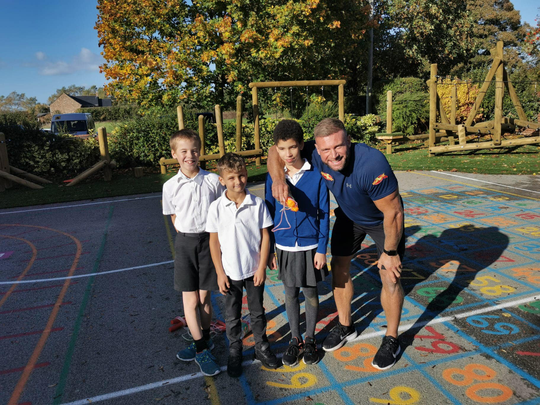
- Providing opportunities for sporting professionals to visit the pupils and inspire them by sharing their achievements
- Sports Ministers promote positive attitudes towards PE and motivating their peers into becoming passionate, respectful young athletes.
Impact
- Children make outstanding progress in PE and enjoy participating in sport.
- Children are all physically active.
- Children understand the importance of exercise and a healthy lifestyle.
- Children have an increased confidence in a range of sports.
- Children take up a variety of sports. This is enabled by the nurture and relationships between staff and children.
- Children talk confidently about PE and their learning.
Our school is an official partner with Beyond the Physical and we utilise their physical literacy-informed and mastery-based PE Scheme of Work to teach transformational PE to our children.
Our curriculum has has been reviewed by the Association for Physical Education through a deep dive by an independent assessor, who validated both the quality and the impact in real school settings.
By creating children who are Masterful Movers, Skilful Solvers, and Confident Connectors, we ensure every child has a purposeful, meaningful, and holistic PE journey during their primary/lower school years—embedding a positive experience of physical activity for life.